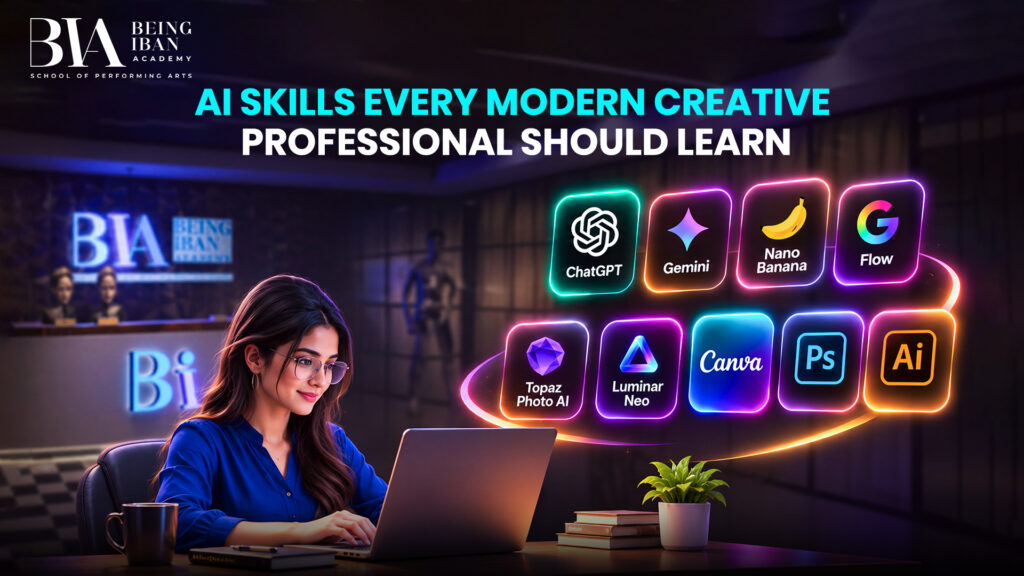
Artificial intelligence is transforming the creative industry, creating new opportunities for designers, photographers, filmmakers, content creators, and digital marketers. From generating fresh ideas to simplifying complex production tasks, AI-powered tools are changing how creative work is planned and delivered. Developing AI Skills for Creative Professionals can help individuals improve productivity, adapt to emerging technologies, and remain competitive in a rapidly evolving industry. Building AI Skills for Creative Professionals helps creators combine emerging technology with original thinking to produce stronger creative work.
However, success with AI involves more than learning to operate software. Creative professionals also need critical thinking, technical knowledge, originality, and responsible decision-making. Here are nine essential skills that can help modern creators make better use of artificial intelligence.
1. Prompt Engineering
Prompt engineering involves writing clear, specific instructions to guide AI tools towards useful results. The quality of a prompt can influence the relevance, accuracy, and style of the generated output.
For example, a graphic designer can describe a target audience, colour palette, visual style, and campaign objective when requesting design concepts. Similarly, a content creator can specify the intended audience, tone, format, and purpose when generating a writing draft.
Learning prompt engineering is one of the most valuable AI Skills for Creative Professionals because it helps users communicate their requirements effectively and refine results through experimentation. Strong AI Skills for Creative Professionals begin with writing precise prompts that communicate the intended result clearly.
2. AI-Assisted Content Creation
AI tools can support the creation of blog outlines, social media captions, video scripts, advertising copy, and content calendars. They can also help creators explore alternative headlines, organise research, and adapt ideas for different platforms.
For example, digital marketers can use AI to develop initial campaign concepts, while writers can generate outlines before producing their own drafts. These capabilities can reduce the time spent on repetitive tasks.
Nevertheless, AI-generated content should be reviewed for accuracy, originality, tone, and audience relevance. Human judgement remains essential for producing meaningful content. Practical AI Skills for Creative Professionals can help writers and marketers develop content ideas while maintaining their unique voice.
3. Generative AI for Visual Design
Generative AI can help designers explore visual concepts, create image variations, and experiment with artistic styles. Tools such as Adobe Firefly and Midjourney can support visual brainstorming and the development of creative references.
Designers can use these tools to test colour combinations, explore campaign aesthetics, or prepare mood-board concepts before developing final artwork. Understanding composition, typography, colour theory, and visual hierarchy helps professionals evaluate the quality of generated designs.
These AI Skills for Creative Professionals can make visual experimentation more flexible while keeping creative direction under human control. Developing AI Skills for Creative Professionals also helps designers evaluate generated visuals and refine them to match project requirements.
4. AI-Assisted Photography and Video Editing
Photography and video production involve numerous tasks, including image retouching, background adjustments, transcription, audio cleanup, and footage organisation. AI-assisted software can simplify selected stages of these workflows.
Photographers may use generative editing features to explore background changes or remove distracting elements. Video creators can investigate automated captioning, transcript-based editing, and AI-assisted visual effects.
However, professionals should check the final output for visual inconsistencies, unnatural edits, and technical errors. Strong knowledge of lighting, composition, camera settings, and storytelling remains important. AI Skills for Creative Professionals are useful for identifying which editing tasks can be automated and which require human judgement.
5. AI in Digital Marketing
Understanding AI in digital marketing is particularly useful for professionals who develop online campaigns and branded content. AI-powered tools can assist with audience research, content planning, keyword exploration, and campaign performance analysis.
For example, a marketer might use AI to brainstorm campaign themes, create initial social media content, or organise ideas for different audience segments. These capabilities can support planning and help teams work more efficiently.
Marketers must still verify information, protect customer data, and assess performance using reliable evidence. AI-generated recommendations should inform decisions rather than replace strategic thinking. For marketing teams, AI Skills for Creative Professionals can support more efficient campaign planning and content development.
6. Critical Thinking and Fact-Checking
AI tools can generate convincing responses that contain errors, unsupported claims, or misleading details. Creative professionals therefore need to evaluate AI outputs carefully before using them in published or client-facing work.
Fact-checking involves verifying claims, reviewing sources, checking visual details, and ensuring that the output meets the project’s objectives. Designers should inspect generated images, while writers should verify factual information and references.
Among the most important AI Skills for Creative Professionals is the ability to recognise when AI output needs correction, additional research, or complete replacement.
7. Ethical AI Use and Data Privacy
Responsible AI use requires an understanding of copyright, consent, confidentiality, and image authenticity. Professionals should review the terms of the tools they use and understand how submitted information may be processed.
For example, photographers should be cautious when uploading identifiable client images, while agencies should avoid sharing confidential project documents without appropriate permission. Creators should also consider whether AI-generated material could mislead audiences or misrepresent real people, products, or events.
Developing ethical awareness helps protect client relationships and supports responsible creative practices. Responsible AI Skills for Creative Professionals include protecting confidential information and checking the permissions associated with AI-generated content.
8. Workflow Automation and Productivity
AI can help simplify repetitive tasks such as organising project notes, preparing content schedules, summarising information, and generating first drafts. Automation can allow creative professionals to spend more time on planning, storytelling, design, and quality control.
The most effective approach is to identify routine tasks that can be supported by AI without compromising accuracy or creativity. Professionals should test automated workflows carefully and review important outputs before delivery.
Learning to integrate AI tools into existing processes is an important part of developing practical AI Skills for Creative Professionals.
9. Adaptability and Continuous Learning
AI technologies continue to evolve, introducing new features, workflows, and creative possibilities. Professionals need to remain curious, evaluate emerging tools, and update their skills as industry requirements change.
Conclusion
Developing AI Skills for Creative Professionals means combining technical ability with creativity, critical thinking, and responsible judgement. Prompt engineering, content creation, visual design, editing, digital marketing, fact-checking, ethical AI use, workflow automation, and continuous learning can all help professionals work more effectively.
AI can accelerate tasks and expand creative possibilities, but human imagination and expertise remain essential. Investing in AI Skills for Creative Professionals can help creators adapt to changing workflows while keeping creativity at the centre of their work. By learning to use AI thoughtfully, creative professionals can build adaptable workflows, strengthen their capabilities, and prepare for new opportunities across the creative industry.