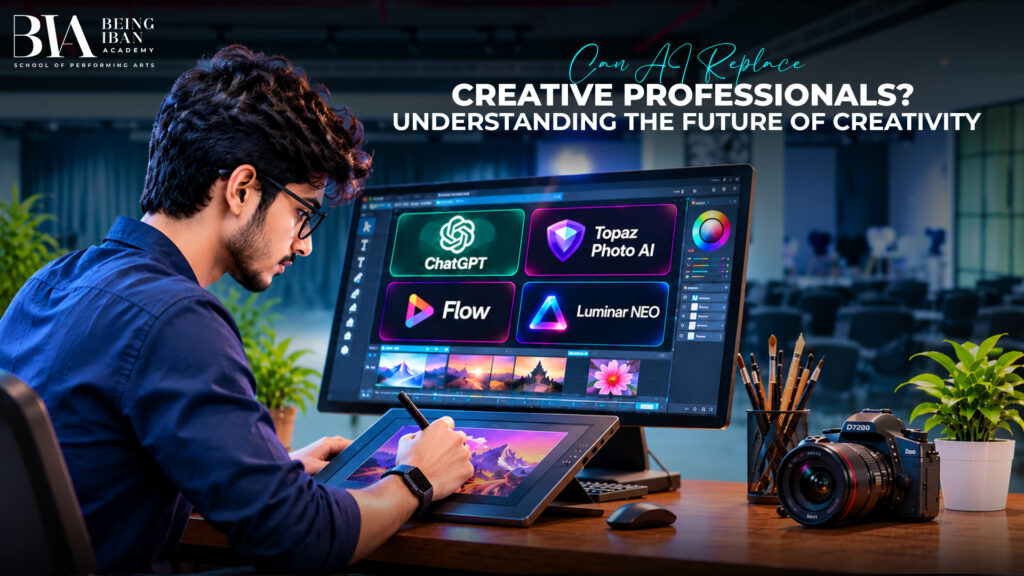
Artificial intelligence is transforming how people write, design, photograph, edit videos and develop digital campaigns. Tasks that once required hours of manual effort can now be assisted by AI-powered tools, creating new opportunities for creative professionals. However, these developments also raise an important question: can technology eventually replace human creativity? Understanding AI and Human Creativity requires looking beyond automation to explore the roles of imagination, emotion, originality and human judgement in creative work.
AI can already support several stages of the creative process. Generative AI applications can produce initial text drafts, explore visual concepts, assist with image editing, generate video elements and suggest ideas for marketing campaigns. These capabilities can improve efficiency, reduce repetitive work and help professionals experiment with different creative possibilities.
However, generating content is not the same as understanding its deeper meaning. Human creators draw inspiration from personal experiences, cultural contexts, emotions and observations of the world. This distinction is central to understanding how artificial intelligence and human imagination can work together. AI and Human Creativity can work together to transform how professionals develop ideas, communicate stories and produce meaningful digital experiences.
1. How AI Is Changing Creative Industries
Artificial intelligence is influencing almost every area of digital content production. Writers can use generative tools to brainstorm topics, develop outlines and explore alternative approaches to storytelling. Graphic designers can experiment with visual concepts, while photographers can use AI-assisted editing to improve selected aspects of their images.
Filmmakers can also explore AI applications for script development, storyboarding, video editing, subtitle generation and visual effects. Digital marketers can use intelligent applications to analyse audience preferences, prepare campaign ideas and develop different versions of promotional content.
These developments demonstrate how AI and Human Creativity are becoming increasingly connected. Rather than completing every task manually, professionals can use intelligent tools to simplify selected activities and dedicate more time to creative direction, communication and storytelling.
Nevertheless, the quality of the final work still depends on the creator’s understanding of the subject, audience and intended message. The growing connection between AI and Human Creativity allows professionals to explore more ideas while spending less time on repetitive tasks.
2. What Makes Human Creativity Different?
Human creativity is influenced by experiences, emotions, imagination and the ability to interpret the world from different perspectives. Creative professionals do more than combine information or produce attractive visuals. They communicate ideas, express emotions and create experiences that connect with audiences.
For example, a filmmaker must understand how a story makes viewers feel. A photographer needs to recognise the significance of a particular moment, while a designer must interpret a client’s objectives and translate them into an effective visual identity.
This is where AI and Human Creativity have different strengths. AI can generate suggestions based on patterns and information, but human creators bring personal interpretation, cultural awareness and emotional understanding to their work.
Original creative direction also requires judgement. Professionals must decide which ideas are meaningful, which visuals communicate the intended message and which creative choices are appropriate for a particular audience.
These qualities make human involvement essential in many creative projects, even when AI tools are part of the workflow. Understanding AI and Human Creativity helps creators recognise the value of combining technological capabilities with personal experiences and emotional understanding.
3. Can AI Replace Creative Professionals?
Artificial intelligence can automate certain activities, but replacing an entire creative profession is a much more complex matter. Many creative roles involve responsibilities that extend beyond producing text, images or videos.
A graphic designer, for instance, must understand brand identity, client expectations, visual hierarchy and communication objectives. A filmmaker must coordinate people, interpret performances and make artistic decisions throughout production. Similarly, a digital marketer must understand audience behaviour and develop strategies that align with business goals.
AI can assist with individual tasks within these roles, but it does not independently manage every creative, strategic and interpersonal responsibility.
The relationship between AI and Human Creativity is therefore better understood as collaboration rather than direct competition. Some tasks may become more automated, and professional workflows may change, but people who can combine creative expertise with technological knowledge may be better positioned to adapt.
The future of creative employment will depend on how industries adopt these technologies and how professionals respond to changing expectations. The collaboration between AI and Human Creativity can help professionals adapt to changing industry expectations without losing their individual creative identities.
4. How AI Supports Different Creative Fields
Artificial intelligence offers different applications depending on the creative discipline. Understanding these uses can help professionals identify where technology may provide practical value.
Graphic Design: AI-powered design applications can generate visual concepts, suggest layouts, remove backgrounds and assist with image editing. Designers can use these capabilities to experiment with ideas before developing final artwork.
Photography: Intelligent editing tools can support image enhancement, object selection, background adjustments and workflow organisation. Photographers can spend more time concentrating on composition, lighting and capturing meaningful moments.
Filmmaking: AI-assisted applications can support script development, storyboard preparation, transcription, rough-cut editing and selected visual effects. Directors and editors can use these tools while retaining control over storytelling and artistic decisions.
Digital Marketing: AI can assist with content planning, caption generation, audience analysis and campaign optimisation. Marketers still need to understand brand positioning and create communication that connects with customers.
Content Writing: Generative applications can help writers brainstorm topics, organise research and prepare initial drafts. Human editing remains necessary to ensure accuracy, originality, clarity and an appropriate writing style.
These examples show how AI and Human Creativity can complement one another across different industries. The most effective approach is to select tools that solve specific problems without compromising creative quality. Different creative industries demonstrate how AI and Human Creativity can complement each other through practical applications and innovative workflows.
5. Essential Skills for the AI-Driven Creative Industry
As artificial intelligence becomes more widely used, creative professionals need to develop a combination of technical and human skills. Knowing how to operate an AI application is useful, but understanding how to evaluate and improve its output is equally important.
Some valuable skills include:
- Generative AI Skills: Understanding how generative applications produce text, images, audio and video.
- Prompt Writing: Learning to communicate instructions clearly to achieve useful creative results.
- Critical Thinking: Evaluating AI-generated information and identifying errors or limitations.
- Creative Problem-Solving: Developing original approaches rather than depending entirely on automated suggestions.
- Storytelling: Communicating ideas through meaningful narratives and visual experiences.
- Digital Communication: Understanding audiences, platforms and brand messaging.
- Responsible AI Use: Considering privacy, copyright, consent, accuracy and originality.
Developing these abilities helps professionals understand the relationship between AI and Human Creativity in practical situations. Instead of simply learning how to generate content, they can learn how to guide technology towards a specific creative objective. Developing relevant professional skills makes AI and Human Creativity more effective in solving complex creative challenges. By combining technical knowledge with imagination, AI and Human Creativity can help professionals produce original work that connects with audiences.
6. Challenges and Responsible Use of AI
Although AI offers several advantages, its growing use also introduces important concerns. AI-generated content may contain inaccurate information, visual inconsistencies or material that resembles existing creative work. Professionals must therefore review outputs carefully before using them in commercial or public projects.
Copyright and intellectual property are particularly important considerations. Creators should understand the licensing conditions of the tools and assets they use. Privacy and consent also matter, especially when AI applications involve personal information, photographs, voices or identifiable likenesses.
Another challenge is maintaining originality. If professionals rely too heavily on automated suggestions, their work may become repetitive or lack a distinctive creative identity.
A responsible approach to AI and Human Creativity requires human oversight at every important stage. Creators should verify information, refine generated material and make sure that the final output reflects their own creative objectives.
AI should be treated as a tool that supports professional judgement, not as a substitute for accountability. Responsible use of technology ensures that AI and Human Creativity remain focused on originality, quality and meaningful communication.
7. Preparing for the Future of Creative Professions
As creative industries evolve, structured learning can help aspiring professionals combine technical knowledge with practical creative abilities. Understanding AI applications alongside traditional creative foundations can provide a useful starting point for adapting to new industry expectations.
Aspiring designers, photographers, filmmakers and digital marketers can benefit from learning how AI tools fit into their chosen disciplines. Combining practical projects with technical learning can also help students understand how to use these applications in professional situations.
The goal should not be to master every new tool available. Instead, learners should develop adaptable skills, strengthen their creative foundations and understand how to evaluate technology critically. A strong understanding of AI and Human Creativity can help aspiring professionals build adaptable skills and prepare for the evolving demands of the creative industry.
Conclusion
AI and Human Creativity are shaping the future of digital content, design, photography, filmmaking and marketing. Artificial intelligence can automate selected activities, accelerate workflows and introduce new ways to explore ideas. However, originality, emotional understanding, cultural awareness and creative direction continue to give human-created work its distinctive value.
AI may change how creative professionals work, but it does not eliminate the importance of human imagination and judgement. Professionals who combine their existing creative abilities with technological adaptability can explore new opportunities and build more efficient workflows.
The future of creativity is unlikely to be defined by humans competing against machines. It will increasingly depend on how intelligently people use technology to strengthen their ideas, solve creative problems and produce meaningful work.