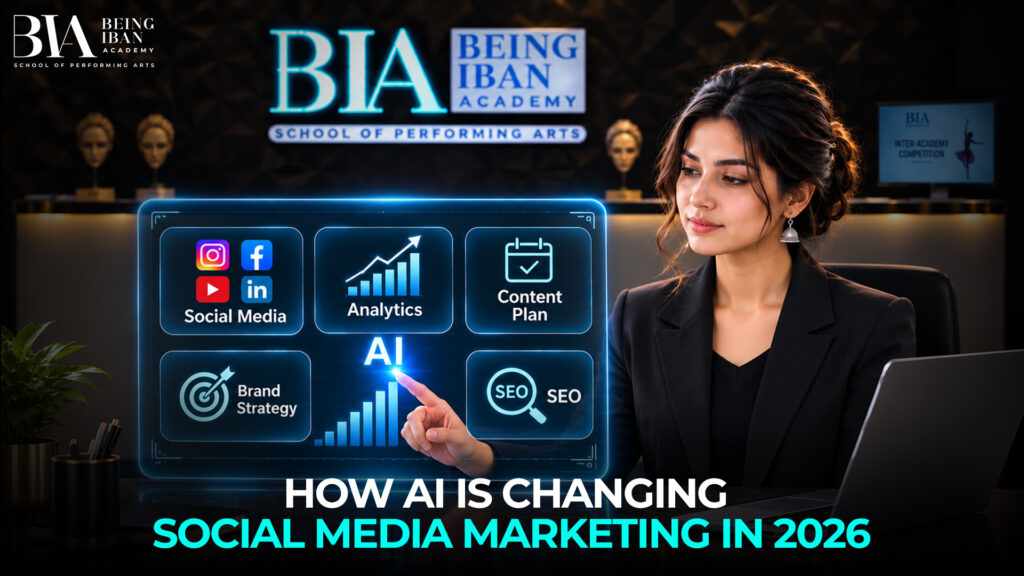
Social media marketing is evolving rapidly as artificial intelligence transforms how brands create content, understand audiences and manage digital campaigns. From generating captions and designing visuals to analysing engagement and automating repetitive tasks, AI-powered technologies are becoming an important part of modern marketing strategies. AI Social Media Marketing is changing how businesses approach online communication, helping marketing teams make informed decisions and develop more effective campaigns.
Understanding these developments can help aspiring marketers, content creators and creative professionals prepare for an industry that increasingly combines technology, data and human creativity. AI is no longer limited to experimentation. It is becoming part of everyday marketing workflows, influencing everything from content planning to audience engagement. AI Social Media Marketing is helping businesses develop more targeted campaigns while improving the efficiency of their digital communication.
1. AI-Powered Social Media Content Creation
One of the most significant applications of AI is content creation. Social media professionals regularly need to develop captions, promotional messages, graphics, videos and other materials for different platforms. AI-powered applications can help simplify these activities.
Marketers can use generative AI tools to brainstorm campaign ideas, write initial captions, develop content calendars, generate visual concepts and adapt posts for different platforms. These applications can also suggest alternative headlines, hashtags and content formats.
According to Metricool’s 2026 State of AI in Social Media Study, 95% of surveyed social media professionals use AI in their work, while 75% use it daily. These findings highlight how AI has become an important part of everyday social media workflows.
AI Social Media Marketing can help teams reduce the time spent on preliminary content development. However, generated content still needs human editing to ensure that it reflects the brand’s personality, communicates accurately and connects with the intended audience. With AI Social Media Marketing, brands can explore different content formats and maintain a consistent publishing schedule across platforms.
2. Audience Analysis and Personalised Marketing
Understanding audience behaviour is essential for successful social media campaigns. Businesses need to know what their customers are interested in, which content formats attract attention and how audiences respond to different messages.
AI-powered analytics can help marketers identify engagement patterns, examine audience preferences and organise customer information. These insights can support audience segmentation and help businesses develop more relevant communication strategies.
For example, a brand may discover that short videos generate stronger engagement among one audience group, while educational posts perform better with another. Marketing teams can use these insights to adjust their content strategies.
AI Social Media Marketing also supports personalisation by helping brands adapt messages for different audience segments. However, businesses must use customer information responsibly and avoid communication that feels intrusive. Effective personalisation should improve the customer experience while respecting privacy. Effective AI Social Media Marketing allows businesses to understand customer interests and create more relevant audience experiences.
3. AI-Driven Social Media Advertising
Social media advertising involves creating campaigns, selecting audiences, testing creative materials and evaluating performance. AI-powered advertising features can support several of these activities.
Marketers can use intelligent tools to explore advertising concepts, generate copy variations, analyse campaign results and identify opportunities for improvement. Some advertising platforms also use machine learning to optimise delivery based on campaign objectives and available performance data.
An effective AI-Driven Digital Marketing Strategy combines these capabilities with a clear understanding of customer needs, brand positioning and business goals.
AI Social Media Marketing can make advertising workflows more efficient by helping marketers test different creative approaches. Nevertheless, professionals should continue monitoring campaign performance, reviewing advertising messages and ensuring that promotional content remains relevant and responsible.
4. Short-Form Video and Visual Content Creation
Short-form video has become an important format across social media platforms. Businesses use videos to introduce products, share information, demonstrate services and communicate brand stories.
AI-assisted video applications can help creators with editing, subtitle generation, background removal, transcription and repurposing existing footage. Generative tools can also support visual experimentation and the development of preliminary creative concepts.
For example, a marketing team can use AI to prepare several versions of a promotional video for different social platforms. The team can then refine the edits to match the format, audience and communication objective of each platform.
AI Social Media Marketing creates new opportunities for businesses to experiment with visual storytelling. However, engaging videos still depend on strong ideas, effective pacing, clear messaging and an understanding of audience expectations. AI Social Media Marketing also helps creative teams experiment with engaging video formats and improve their visual storytelling strategies.
5. Chatbots and Social Media Community Management
Managing social media communities requires regular communication with customers and followers. Businesses receive questions about products, services, orders, availability and general enquiries across multiple digital channels.
AI-powered chatbots and automated response systems can help businesses handle common questions and provide basic information. These tools can also support enquiry management by directing users towards relevant resources or appropriate customer service teams.
For small businesses, this can make routine communication more manageable. However, automated responses cannot replace human understanding in every situation.
AI Social Media Marketing works best when automation handles straightforward interactions while human representatives manage complex enquiries, complaints and sensitive conversations. This balance helps businesses maintain efficiency without losing the personal connection that customers value.
6. Social Media Analytics and Performance Tracking
Measuring campaign performance is an important part of digital marketing. Businesses need to understand whether their content is reaching the intended audience and achieving the desired objectives.
AI-powered analytics can help marketers examine engagement, reach, clicks, conversions and other performance indicators. These insights can reveal patterns that may not be immediately visible through manual analysis.
For example, marketers can compare different content formats, examine audience responses and identify which campaign elements require improvement. These findings can support more informed decisions about future content and advertising activities.
AI Social Media Marketing can therefore strengthen performance analysis by helping professionals interpret available data and identify potential opportunities. However, marketers must understand the business context behind the numbers rather than relying on automated recommendations alone.
7. Authenticity and Responsible AI Marketing
Although AI offers many advantages, successful social media marketing still depends on trust and authenticity. Audiences value original ideas, relatable communication and content that reflects genuine brand values.
AI-generated content may contain factual errors, repetitive expressions or visual inconsistencies. Marketing teams must review all outputs carefully before publishing them. They should also consider copyright, privacy, licensing and transparency when using AI-generated text, images, videos or audio.
HubSpot’s 2026 social media research highlights the continuing importance of authenticity as AI becomes more widely used.
The relationship between automation and human creativity is particularly important in brand communication. AI Social Media Marketing should support a brand’s identity rather than make its communication appear generic or disconnected from its audience.
Human judgement remains essential for checking information, maintaining brand consistency and ensuring that marketing messages are appropriate. Responsible AI Social Media Marketing combines technological efficiency with authenticity, transparency and meaningful audience communication.
8. Preparing for the Future of AI Social Media Marketing
As social media platforms and marketing technologies continue to evolve, professionals need to develop a combination of technical and creative abilities. Understanding AI applications alongside traditional marketing principles can help aspiring marketers adapt to changing industry expectations.
Some useful skills include:
- AI Digital Marketing Skills: Understanding how AI supports campaign planning, content development and performance analysis.
- Prompt Writing: Communicating clear instructions to generative AI applications.
- Content Strategy: Planning relevant content for different platforms and audience groups.
- Audience Research: Understanding customer behaviour and engagement patterns.
- Creative Thinking: Developing original ideas that reflect brand identity.
- Analytics: Interpreting campaign data and identifying opportunities for improvement.
- Responsible AI Use: Considering privacy, accuracy, copyright and transparency.
Learning about AI Tools for Social Media Marketing can help professionals understand how different applications fit into their workflows.
Conclusion
AI Social Media Marketing is changing how businesses create content, analyse audiences, manage campaigns and communicate with customers in 2026. Artificial intelligence can improve efficiency, support data-driven decisions and introduce new possibilities for digital marketing.
However, successful campaigns still depend on human creativity, strategic thinking, authenticity and a clear understanding of audience needs. Businesses that combine intelligent tools with meaningful communication can develop more adaptable marketing workflows.
For aspiring professionals, learning how to use AI responsibly while strengthening traditional marketing skills can create valuable opportunities. The future of social media marketing will not simply be about automation; it will be about using technology intelligently to build stronger connections between brands and their audiences.