Social media has become much more than a platform for sharing photographs, videos and personal updates. Businesses now use it to build brand awareness, connect with customers, promote products and generate leads. As companies increasingly depend on digital channels to communicate with their audiences, developing strong Social Media Marketing Skills can help aspiring professionals recognise new career opportunities and prepare for the modern marketing industry.
From small businesses and startups to established brands and educational institutions, organisations need professionals who understand how to create meaningful digital interactions. Social media marketing combines creativity, communication, audience research and analytical thinking. It also offers opportunities to work across different industries, making it a valuable skill for students, graduates, entrepreneurs and working professionals. Developing Social Media Marketing Skills can help beginners understand digital audiences and contribute to effective brand communication.
1. Growing Demand for Social Media Marketing Professionals
One of the biggest reasons to learn social media marketing is the growing importance of online communication in business. Customers frequently use social platforms to discover brands, explore products, read reviews and interact with companies before making purchasing decisions.
Businesses therefore need professionals who can manage their online presence and develop effective communication strategies. These responsibilities extend beyond publishing regular posts. Marketers must understand brand positioning, audience expectations, content planning and campaign objectives.
Professionals with strong Social Media Marketing Skills can explore opportunities in digital agencies, corporate marketing teams, startups, retail businesses, hospitality, education and many other sectors.
The growing demand for digital communication also creates opportunities for freelancers and independent consultants who manage social media accounts for multiple clients. Businesses increasingly value Social Media Marketing Skills because they support customer engagement, brand visibility and online growth.
2. Multiple Career Opportunities Across Industries
Social media marketing offers several career paths depending on an individual’s interests and abilities. Some professionals focus on content creation, while others specialise in advertising, analytics, strategy or community management.
Common career opportunities include:
- Social Media Executive: Manages brand accounts, publishes content and monitors engagement.
- Social Media Manager: Develops strategies, coordinates campaigns and manages social media teams.
- Content Strategist: Plans content themes, publishing schedules and audience communication.
- Community Manager: Builds relationships with followers and responds to audience interactions.
- Performance Marketing Executive: Manages paid social campaigns and evaluates advertising results.
- Digital Marketing Executive: Supports marketing activities across social media, search engines, email and other channels.
- Freelance Social Media Consultant: Provides social media planning and management services to businesses.
Developing Social Media Marketing Skills can provide a starting point for these roles. With experience, professionals may progress towards campaign management, brand strategy and digital marketing leadership positions.
3. Content Creation and Creative Communication
Content is at the centre of every successful social media strategy. Businesses need engaging posts, informative videos, creative graphics and compelling captions to communicate their messages.
This makes content creation one of the most important Social Media Marketing Skills for aspiring professionals. Marketers should understand how to develop content that reflects a brand’s personality while addressing the interests of its target audience.
Important content creation abilities include:
- Writing engaging captions and headlines.
- Developing social media content calendars.
- Creating graphics and promotional designs.
- Planning short-form videos and reels.
- Using storytelling to communicate brand messages.
- Adapting content for different social platforms.
For example, a restaurant may use attractive food photography, customer testimonials and short videos to showcase its services. An educational institution may publish student experiences, course information and informative videos to connect with prospective learners.
Successful content creation requires more than visual appeal. Every post should have a clear purpose, whether it is to inform, entertain, engage or encourage an audience to take action. Strong Social Media Marketing Skills help professionals create content that attracts attention while communicating a clear brand message.
4. Understanding Different Social Media Platforms
Every social media platform has its own audience behaviour, content formats and communication style. Professionals must understand these differences to develop effective campaigns.
Instagram is widely used for visual storytelling, short-form videos and brand engagement. Facebook supports community building, business pages and advertising. LinkedIn is particularly useful for professional networking, B2B communication and industry-related content. YouTube supports long-form videos, educational content and brand storytelling.
Understanding these platforms helps marketers choose appropriate channels for different business objectives.
For instance, a fashion brand may focus on Instagram to showcase products visually, while a professional training institute may use LinkedIn and YouTube to share educational content and industry insights.
Strong Social Media Marketing Skills involve selecting platforms strategically rather than trying to publish identical content everywhere. Practical Social Media Marketing Skills enable marketers to adapt their content strategies according to the unique features of different platforms.
5. Audience Research and Customer Engagement
Understanding an audience is essential for developing relevant social media campaigns. Businesses need to know who their customers are, what interests them and how they interact with digital content.
Audience research involves examining demographics, interests, preferences, online behaviour and engagement patterns. These insights help marketers develop content that is more closely aligned with customer expectations.
Customer engagement is equally important. Responding to comments, answering questions, acknowledging feedback and participating in relevant conversations can help businesses build stronger online relationships.
For example, a skincare business may discover that its audience frequently asks questions about product ingredients and skincare routines. It can use this information to create educational posts, short videos and interactive question-and-answer sessions.
These activities demonstrate how Social Media Marketing Skills can support both communication and business growth. Effective Social Media Marketing Skills involve understanding customer preferences and developing communication that encourages meaningful interactions.
6. Social Media Analytics and Performance Measurement
Modern social media marketing depends on measurable outcomes. Publishing content regularly is not enough; professionals must understand whether their activities are achieving the intended objectives.
Analytics tools help marketers evaluate campaign performance and identify opportunities for improvement. Meta Business Suite and platform-specific analytics provide useful information about audience engagement and content performance.
Some important metrics include:
- Reach: The number of unique users who see content.
- Impressions: The total number of times content is displayed.
- Engagement Rate: The level of interaction with published content.
- Click-Through Rate: The percentage of users who click a particular link or advertisement.
- Conversions: Actions such as enquiries, registrations or purchases.
- Follower Growth: Changes in the size of a brand’s audience.
Understanding these metrics helps marketers recognise which content formats and strategies are working.
Analytical thinking is therefore an essential part of Social Media Marketing Skills. Professionals should be able to interpret reports, identify patterns and recommend improvements based on campaign results. Analytical Social Media Marketing Skills help professionals evaluate campaign results and identify opportunities for improvement.
7. Paid Social Media Advertising
Organic content helps businesses build relationships with audiences, but paid advertising can extend their reach and support specific marketing objectives.
Platforms such as Meta Ads Manager allow businesses to create targeted campaigns across Facebook and Instagram. Marketers can select campaign objectives, define audiences, manage budgets and monitor advertising performance.
Learning paid social media advertising involves understanding:
- Campaign objectives and advertising formats.
- Audience targeting and segmentation.
- Advertising copy and creative development.
- Budget allocation and bidding.
- Conversion tracking and performance analysis.
- A/B testing and campaign optimisation.
For example, an educational institute promoting a new course may run an advertisement targeting students and working professionals in a particular location. The campaign can be evaluated through enquiries, registrations and cost per lead.
Professionals who understand both organic social media management and paid advertising can contribute to a wider range of business objectives.
8. AI Tools for Social Media Marketing
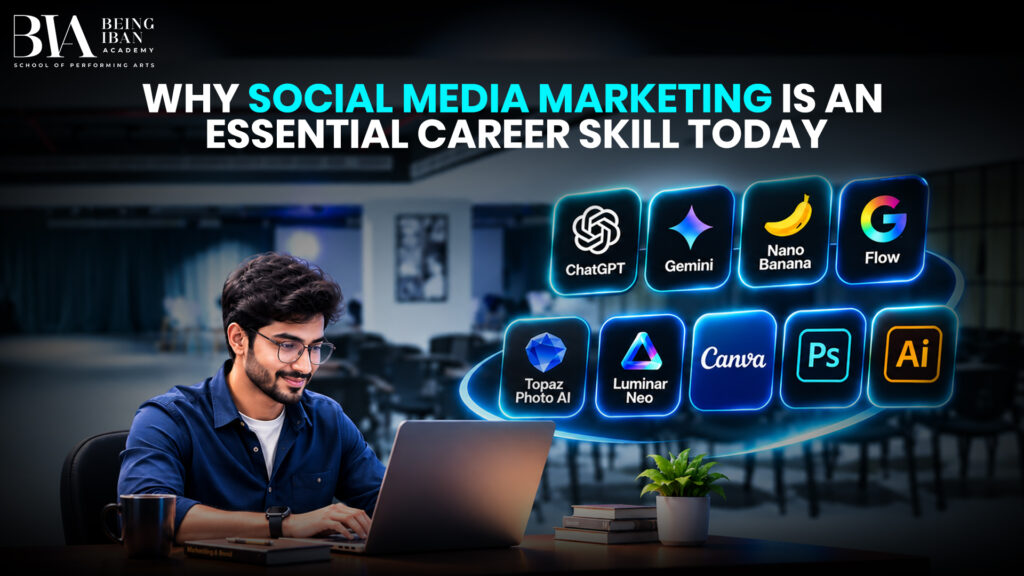
Artificial intelligence is changing how marketing teams plan campaigns, develop content and analyse audience behaviour. AI Tools for Social Media Marketing can help professionals brainstorm ideas, draft captions, explore creative variations and organise content workflows.
AI-assisted tools may also support audience research, performance analysis, content repurposing and routine marketing tasks.
For example, a marketer can use generative AI to develop initial ideas for a monthly content calendar, prepare different caption options and explore campaign themes. The final content should then be reviewed and refined to ensure that it reflects the brand’s voice and audience expectations.
However, AI should support rather than replace human creativity. Professionals must verify information, maintain originality and consider privacy and copyright requirements.
Learning to combine AI technology with strong Social Media Marketing Skills can help aspiring professionals adapt to changing industry practices. Combining AI knowledge with Social Media Marketing Skills allows professionals to improve content workflows without losing creative originality.
9. Social Media Marketing Supports Entrepreneurial Opportunities
Social media marketing is valuable not only for employment but also for entrepreneurship. Individuals who understand digital platforms can use their knowledge to promote personal brands, launch online businesses or provide marketing services to clients.
Small businesses often need affordable ways to improve their online visibility. Freelancers with practical social media knowledge can help these organisations plan content, manage accounts, develop creative campaigns and analyse performance.
Entrepreneurs can also use social media to test product ideas, communicate with potential customers and build communities around their brands.
For someone interested in starting an independent career, developing Social Media Marketing Skills can provide a foundation for offering services such as content planning, social media management, advertising and digital strategy.
Practical experience and a portfolio of completed projects can help establish professional credibility.
10. Social Media Marketing Builds Broader Digital Marketing Knowledge
Social media marketing is closely connected to other areas of digital marketing. Skills developed through social media campaigns can support learning in search engine optimisation, content marketing, paid advertising, email marketing and analytics.
For example, a social media campaign may direct users to a website where SEO-friendly content provides further information. An email campaign may then nurture those visitors through relevant updates and offers.
Understanding these connections helps professionals see how different digital channels work together.
A broader understanding of digital marketing can also create opportunities to move into specialised roles involving campaign planning, performance marketing and integrated brand communication.
11. How to Develop Social Media Marketing Skills Through Practical Learning
Learning social media marketing requires a combination of theoretical knowledge and practical application. Beginners should explore different platforms, understand their features and practise developing content for specific audiences.
Some useful ways to gain experience include:
- Creating a social media account for a personal project.
- Developing a sample content calendar for a business.
- Designing social media posts and short-form videos.
- Practising audience research and competitor analysis.
- Exploring social media analytics dashboards.
- Creating sample advertising campaigns.
- Building a portfolio of content and campaign examples.
Internships, freelance assignments and collaborative projects can also help learners understand professional expectations.
12. The Future of Social Media Marketing Careers
Social media platforms continue to evolve, creating new opportunities and challenges for marketing professionals. Changes in content formats, platform algorithms, audience expectations and artificial intelligence are influencing how businesses communicate online.
Short-form video, creator collaborations, social commerce, personalised content and AI-assisted campaign planning are among the areas shaping modern social media strategies.
Professionals will need to remain curious and adaptable. They should regularly explore new platform features, understand changing audience behaviour and update their knowledge of marketing tools.
The future of social media marketing will also require stronger human capabilities. Creativity, communication, critical thinking, cultural awareness and responsible decision-making will remain important even as automation becomes more common.
Continuously improving Social Media Marketing Skills can help professionals stay relevant and explore new career opportunities.
13. Personal Branding and Professional Networking
Social media marketing is not limited to promoting businesses. Professionals can also use digital platforms to build their personal brands, showcase their expertise and connect with industry communities.
LinkedIn, Instagram and other platforms provide opportunities to share professional achievements, creative projects, industry insights and useful information. A well-maintained professional profile can help individuals demonstrate their knowledge and attract potential employers, clients and collaborators.
Developing Social Media Marketing Skills can help professionals understand how to communicate their expertise, create consistent content and build a recognisable online identity. For students and beginners, sharing sample projects, campaign ideas and creative work can also become an effective way to demonstrate practical abilities.
Professional networking through social media can lead to internships, freelance assignments, collaborations and employment opportunities. Learning how to communicate professionally and engage with relevant industry communities is therefore an important part of career development. Strong Social Media Marketing Skills help individuals build professional credibility and communicate their expertise effectively across digital platforms.
14. Influencer Marketing and Brand Collaborations
Influencer marketing has become an important part of how businesses connect with specific audiences. Brands collaborate with content creators and influencers who have established communities and can communicate product experiences in an engaging way.
Social media professionals may be responsible for identifying suitable creators, planning collaboration campaigns, coordinating content and evaluating campaign outcomes. They must consider audience relevance, engagement quality, brand alignment and campaign objectives rather than focusing only on follower numbers.
Understanding Social Media Marketing Skills can help professionals plan these collaborations more strategically. They should also learn about disclosure requirements, authentic endorsements and transparent communication when working with influencers.
These capabilities are particularly useful in industries such as fashion, beauty, travel, food, education and lifestyle, where creator-led content can support brand discovery and customer engagement.
15. Building a Strong Social Media Marketing Portfolio
A portfolio can help aspiring professionals demonstrate what they can do rather than simply listing the tools they have studied. It provides potential employers and clients with examples of practical work and creative thinking.
Beginners can include sample content calendars, social media graphics, video concepts, audience research, campaign strategies and performance reports. They can also create a demonstration campaign for a fictional brand or manage a personal project to gain experience.
A strong portfolio should explain the objective of each project, the strategy followed, the content developed and the results achieved where real performance data is available.
Combining practical projects with well-developed Social Media Marketing Skills can help candidates communicate their strengths more confidently during interviews and client discussions. Continuously improving Social Media Marketing Skills can help aspiring marketers create stronger portfolios and demonstrate their professional capabilities.
Conclusion
Social media marketing has become an important professional skill because businesses across industries depend on digital platforms to communicate, build relationships and achieve measurable results. It combines creativity, audience understanding, content development, advertising and performance analysis.
Developing strong Social Media Marketing Skills can help aspiring professionals explore careers in social media management, content strategy, digital advertising, community management and freelance consulting. Continuously developing Social Media Marketing Skills can help aspiring professionals remain competitive as digital platforms and marketing technologies evolve. Consistently strengthening Social Media Marketing Skills can help professionals adapt to emerging trends, use new technologies and build long-term career opportunities.
With practical experience, continuous learning and an understanding of emerging AI tools, learners can build a strong foundation for the evolving marketing industry. As digital communication continues to influence business growth, social media marketing knowledge will remain valuable for professionals who want to build relevant and adaptable careers.