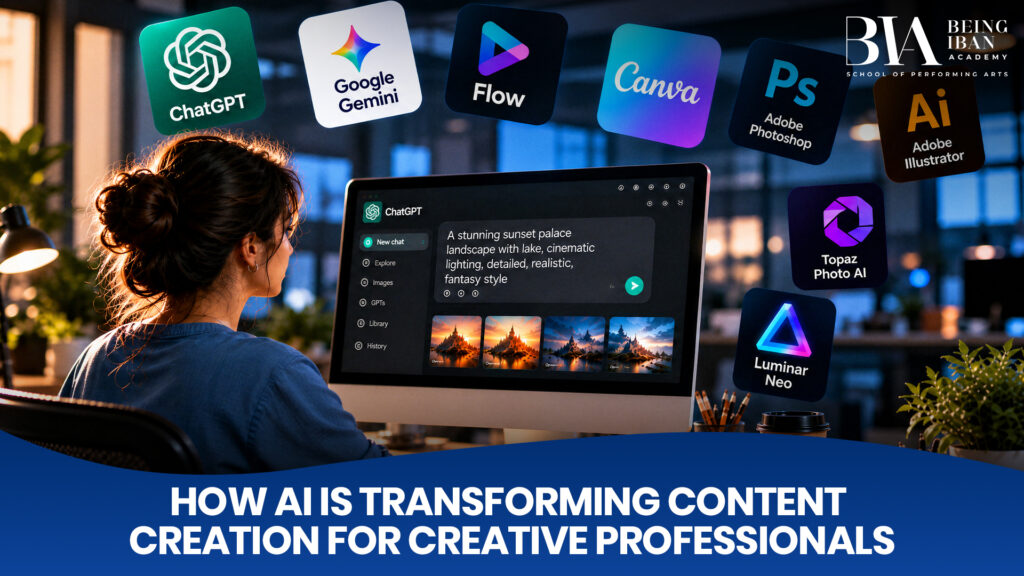
Artificial intelligence is transforming how ideas are developed, content is produced, and creative projects are delivered. From digital marketing and graphic design to photography and filmmaking, AI is helping professionals explore new possibilities and reduce time spent on repetitive tasks. AI Content Creation for Creative Professionals is becoming an important part of modern creative workflows, enabling individuals to improve productivity while maintaining their unique artistic vision.
Understanding how AI supports content creation can help designers, writers, photographers, filmmakers, and digital marketers adapt to changing industry demands. Here are seven ways artificial intelligence is influencing creative work. AI Content Creation for Creative Professionals is making it easier to turn initial ideas into engaging digital content across multiple platforms.
1. Generate Ideas and Develop Creative Concepts
One of the biggest advantages of AI is its ability to support brainstorming and early-stage planning. Creative professionals can use AI tools to explore campaign ideas, develop storylines, prepare content outlines, and experiment with different approaches to a project.
For example, a digital marketer can brainstorm social media campaigns, while a filmmaker can explore potential story concepts before writing a script. Designers can also use AI-generated references to experiment with colours, layouts, and visual styles.
AI Content Creation for Creative Professionals makes idea development more flexible by helping users explore multiple possibilities quickly. However, creators should refine these suggestions using their experience, audience knowledge, and original thinking. With AI Content Creation for Creative Professionals, creators can explore different concepts before choosing the most suitable direction for a project.
Key benefit: Faster brainstorming and a wider range of creative possibilities.
2. Improve Writing and Content Production
AI writing tools can assist with creating blog outlines, social media captions, video scripts, product descriptions, and marketing copy. They can also help organise information, suggest alternative headlines, and adapt content for different platforms.
For content creators, this can reduce the time required to move from an initial idea to a workable draft. A digital marketing team, for example, can use AI to develop a preliminary content calendar and then refine each piece according to its brand voice and campaign objectives.
Nevertheless, AI-generated writing requires human review. Accuracy, tone, originality, and audience relevance must be checked before publication. AI Content Creation for Creative Professionals can support content planning while allowing writers to retain control over tone, accuracy, and originality.
Key benefit: More efficient content development without sacrificing editorial quality.
3. Simplify Image Editing and Graphic Design
Artificial intelligence is changing how designers and photographers approach visual production. AI-powered tools can help remove unwanted objects, modify backgrounds, generate visual elements, and explore alternative design concepts.
Graphic designers can use these features to develop initial advertising concepts, while photographers can experiment with selected editing tasks. These capabilities can be especially useful when producing multiple creative variations for clients.
AI Content Creation for Creative Professionals can streamline parts of the visual workflow, but technical knowledge remains essential. Understanding composition, lighting, typography, colour theory, and visual hierarchy helps professionals determine whether generated results are appropriate for the final project. AI Content Creation for Creative Professionals can support content planning while allowing writers to retain control over tone, accuracy, and originality.
Key benefit: Faster visual experimentation and more efficient editing workflows.
4. Enhance Video Production and Editing
Video production often involves scripting, footage organisation, editing, transcription, and post-production. AI-assisted tools can help automate or simplify selected tasks, including subtitle generation, audio cleanup, transcript-based editing, and the creation of preliminary visual sequences.
Content creators can use these capabilities to produce videos for social media, educational platforms, advertising campaigns, and digital storytelling projects. AI tools can also help teams test creative concepts before committing to a complete production.
However, generated video and automated edits can contain inconsistencies. Creators should review pacing, continuity, sound quality, and visual details to ensure that the finished video meets professional standards. For video creators, AI Content Creation for Creative Professionals can simplify selected production tasks and accelerate concept development.
Key benefit: More efficient video production and streamlined post-production workflows.
5. Personalise Content for Different Audiences
Modern audiences interact with content across websites, social media platforms, email campaigns, and video channels. AI can help creative teams adapt messaging to different formats, audience preferences, and campaign objectives.
For example, a marketer might transform a long article into shorter social media posts, prepare different headline variations, or develop content ideas for different customer segments. AI can also assist with analysing audience feedback when suitable data and tools are available.
AI Content Creation for Creative Professionals can support more targeted communication, but personalisation should remain relevant and respectful. Teams must protect customer information and avoid relying on unsupported assumptions about their audiences. AI Content Creation for Creative Professionals can help teams adapt messages to different platforms while maintaining a consistent brand identity.
Key benefit: More adaptable content and more focused communication.
6. Develop Practical Generative AI Skills
Using AI effectively requires more than knowing how to operate a particular application. Creative professionals need to develop skills in prompt writing, output evaluation, editing, fact-checking, and workflow integration.
They should also understand when AI is suitable for a task and when human expertise is necessary. For instance, a designer must evaluate whether an AI-generated image fits the brand, while a writer must ensure that AI-assisted content is accurate and engaging.
Key benefit: Better judgement, stronger technical adaptability, and more effective use of AI tools.
7. Maintain Originality and Responsible AI Practices
Although AI offers many creative advantages, it also raises important questions about copyright, consent, privacy, and authenticity. Professionals should understand the terms of the tools they use and consider whether generated material is appropriate for its intended purpose.
Before uploading client photographs, confidential documents, or proprietary project information, creators should review the relevant privacy policies and permissions. They should also check AI-generated outputs for inaccurate information, visual errors, bias, and potentially misleading details.
Human creativity remains central to meaningful content. AI can suggest options and simplify tasks, but cultural understanding, emotional intelligence, storytelling, and creative judgement help determine what genuinely connects with an audience.
Key benefit: Greater trust, stronger creative integrity, and more responsible use of technology.
Conclusion
AI Content Creation for Creative Professionals is changing how people brainstorm, write, design, edit videos, and develop digital campaigns. By supporting repetitive tasks and expanding opportunities for experimentation, AI can help creative teams work more efficiently and explore new directions.
The most effective approach is to combine AI capabilities with technical knowledge, originality, critical thinking, and responsible decision-making. By developing practical AI skills while preserving their individual creative perspectives, professionals can adapt to an evolving industry and create meaningful content for modern audiences.